The Best Face-Pull Variation You’re Not Doing

John Rusin, DPT, CSCS
November 30, 2018
•
3 min read
It’s safe to say I have a slight obsession with the face pull. Anyone familiar with my brand of hypertrophy training and programming knows this. But the truth is that I honestly believe them to be one of the biggest-bang-for-your-buck shoulder movements on earth.
Why so much love? Because over the last decade, I’ve seen the face pull prove itself over and over again to be the most effective direct shoulder training exercise in my programming arsenal. It builds big, strong, and stable shoulders and upper backs, while also helping to bulletproof the shoulders from chronic aches and pains in the process.
Honestly, those who can’t benefit from this staple movement are few and far between. If you’ve been injured, it can be a game-changing component of rehab. If you’re not injured, it’s the perfect pre-hab, or just a way to prep your shoulders on a pressing day. And if you’re someone who is trying to pull three times more than you push—the essential ratio for shoulder health—high-rep face pulls are the easiest way to get your numbers headed in the right direction.

So, what could possibly make it better? One simple change that you probably didn’t see coming, but that you can do without having to buy any extra equipment other than a band (which, seriously, you should already have). After 18 months of beta testing this simple yet highly effective face-pull variation, I can definitively say this is the best variation that you’ve never done.
Check it out.
The Handless Banded Cable Face Pull
This variation is basically a combination of the best parts of the two most common face-pull variations: the banded face pull, and the cable rope face pull. I see both of these performed in the gym daily, and I program both of them in the Bodybuilding.com All Access guide Unstoppable: The Ultimate Guide to Training Through Injury. So, for anything to improve on either of them is a tall order!
One thing I love about the traditional banded face pull is that it offers more resistance at the tail end of the movement where the hands are close to the face, and less at the front side of the movement where many of the muscles of the upper back, including the posterior deltoid and teres group are weakest. This makes it ideal for warm-ups, but also for beginners, people coming back from injury, or anyone who doesn’t have a lot of equipment.
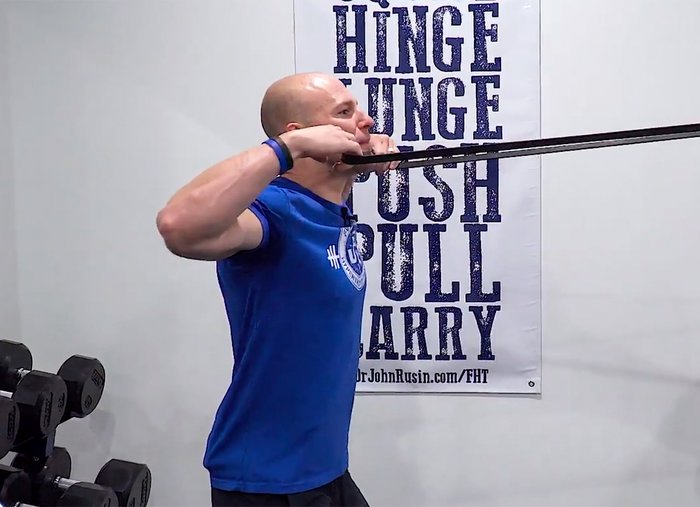
The clear drawback to band-only face pulls is the inability to dial in the load exactly. That’s where the cable face pull with rope attachment comes into play. When the goal is to train the face pull with more of a strength or hypertrophy emphasis, which I think is a great idea for long-term strength or muscle development, being able to nudge the weight up over time is a must.
However, as loading increases and efforts become heightened, it becomes harder and harder to avoid having to death grip the ropes. While there are plenty of movements where gripping the weight hard provides a benefit, the face pull isn’t one of them. When you grip the rope hard, you initiate what’s known as “the irradiation effect,” transferring tension from the hands, up through the forearms, into the biceps and triceps, and finally into the shoulders and upper back.
As all of these muscle groups turn on, the movement becomes stronger as a whole, but it becomes less targeted on the small intrinsic muscles of the posterior shoulders. Those are what you’re trying to strengthen with face pulls in the first place.
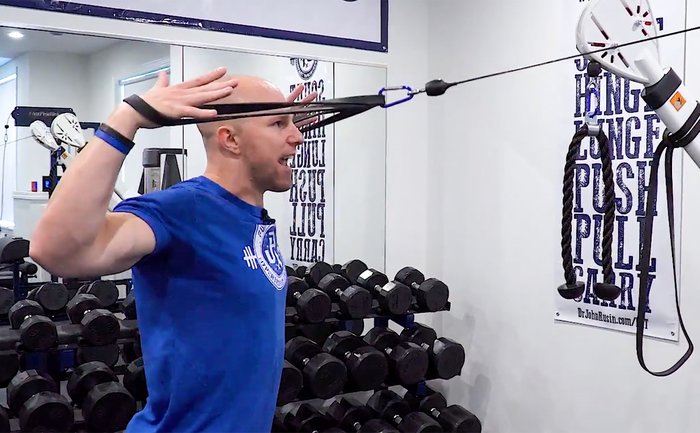
So here’s the solution: Place a medium resistance circular band on the cable setup, looping each end of the band around your wrists. This way, you can take away the need for your hands to grip during the face-pull movement at all. This small change allows you to have more freedom of movement, giving you access to both internal and external shoulder rotation more that the more common rope setup would allow.
Another benefit? It keeps you seriously strict. One key drawback of rope cable face pulls is that you can lean against the weight with your body, allowing you to cheat the movement without even knowing it. But in the hands-free variation, the bands will pull and lengthen if the movement becomes too quick, forceful, or uncontrolled. This makes you dial in proper technique, constant tension, and muscular recruitment of the rear delts and upper back—and only those muscles.
How to Program It
With this setup, expect the loads you are used to using on the cable stack to be reduced by 25-50 percent right away. No, this isn’t a bad thing.
Remember, a key tenet of pain-free training is maximizing muscular targeting while minimizing joint stress. By recruiting the right muscles and minimizing compensation from other muscles, you’ll limit unnecessary stress on the wrist, elbow, shoulder joint, and spine, and put it squarely where it belongs.
Train this movement in the traditional hypertrophy rep scheme between 8-15 reps at minimum. You can also ride it all the way up to metabolic stress-based schemes that can exceed 50 repetitions.
As the weights get heavier for stronger lifters, two medium resistance bands, or a heavy single band, may be required. But that’s a while down the road. To start, just enjoy the feeling of doing face pulls right, and your shoulders and upper back with thank you!
from Weight Loss Insider https://ift.tt/2Eb0Nef
via Best Weight Loss Supplement
Brandan Fokken’s Full-Body Circuit Workout

Kailan Kalina
November 30, 2018
•
4 min read
Body splits have been around since the dawn of bodybuilding. They remain a favored training framework among bros far and wide. Sometimes these workouts can be time-consuming and require you to train 5-6 days a week. This might be some lifting-lovers’ dream schedule, but it’s not everyone’s reality.
Still, just because you can’t devote a full two hours to beefing up your chest, arms, or legs in a single session isn’t an excuse to skip the gym entirely. Whether you’re looking to train less often and more efficiently, or just mix up your bread-and-butter split, a full-body approach can give you that satisfying burn and a body that still looks like you lift big.
This quickie circuit from Brandan Fokken will have you in and out of the gym fast. If you only go to the gym 2-3 times per week, Fokken recommends doing this workout every session. If you’re a more frequent gym-goer, throw it in once a week or every other week.
Brandan Fokken’s Full-Body Circuit Workout
Brandan Fokken’s Full-Body Circuit Workout
1
Circuit:
Complete 3 rounds. No rest between exercises. Rest 30-120 sec. between circuits.
Calf Press
Perform on leg press machine.
10 reps


Reverse Flyes
Bent-over position.
10 reps


Technique Tips
Single-Arm Dumbbell Preacher Curl
With your triceps placed on top of the preacher bench and the dumbbell held at your shoulder, slowly lower the weight down until your arm is extended. Let your biceps fully stretch before curling the weight back up. Squeeze hard at the top and hold before performing the next rep.
Rope Triceps Pull-down
Grip the rope with your palms facing together and stand tall with your shoulders back. Keep your torso inclined slightly forward toward the weight stack. Your forearms should be parallel to the floor to start. Your elbows should remain locked in at your sides throughout the movement. Bring the rope down toward your upper thighs using your triceps. Finish with your arms fully extended. At this point, focus on the contraction. Slowly bring the weight back to start.
Leg Press
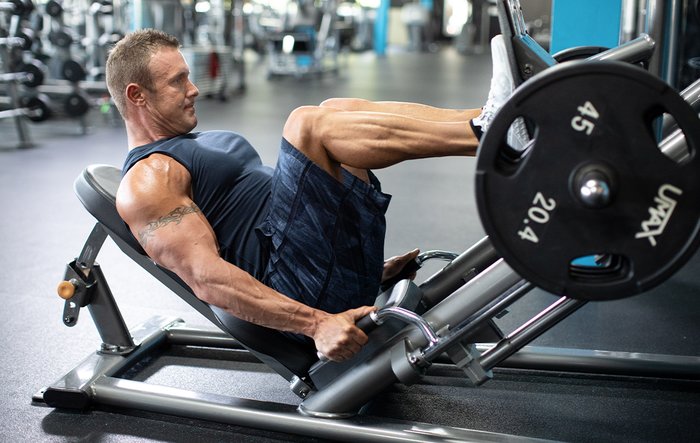
Place your feet about shoulder-width apart and high enough on the platform that your knees stay over your ankles and don’t glide past your toes during reps. Fokken says to put enough weight on the machine to push your limits, but not so much that you can’t complete all 10 reps on the second and third rounds of the circuit.
Calf Press
Do these on the leg press machine using the same weight as above. Before unracking the weight, place your toes on the bottom of the platform. Keep your knees slightly bent. Press up through your toes, pushing the weight up with the balls of your feet. Then, flex your foot back toward you, allowing a full stretch in the calves before you continue your next rep. Remember—calves grow with big weight and lots of reps.
Plate Front Raise
Standing tall with your shoulders pulled back, hold the plate on both sides. Raise it in front of you with straight arms. As soon as your arms are parallel to the ground, hold for a second. Return to the start position. Keep an easy tempo and stay strict on both halves of the rep.
Machine Chest Press
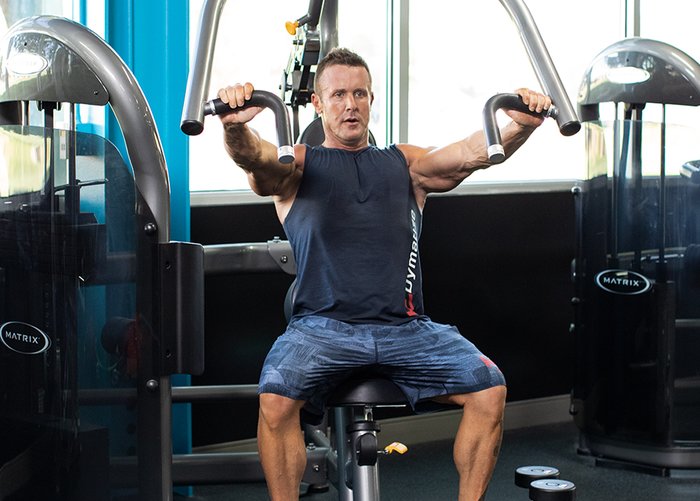
Plant your feet on the floor and sit up tall with your shoulder blades pulled back on the pad behind you. Keep your elbows somewhat tucked in. Flaring them up too much can cause strain on the shoulder joints. Push out forcefully and squeeze into your pecs for a one- or two-count before returning to start.
Bent-Over Rear Delt Fly
In the bent-over position, your knees should be slightly bent and your back flat. Start with your arms hanging straight down, dumbbells in hand and palms facing either in or out. Try both to see what works best for you! Raise the dumbbells out to your sides with a slight bend in your elbows. Go all the way until you feel a squeeze in your upper back.
Seated Cable Row
The key here is to keep your upper body rigid. Do not rock back and forth as you pull and extend. Sit up tall with your shoulders back and row directly into your midsection. Visualize pulling with your middle back. Don’t let your arms do all the work.
Pull-Up
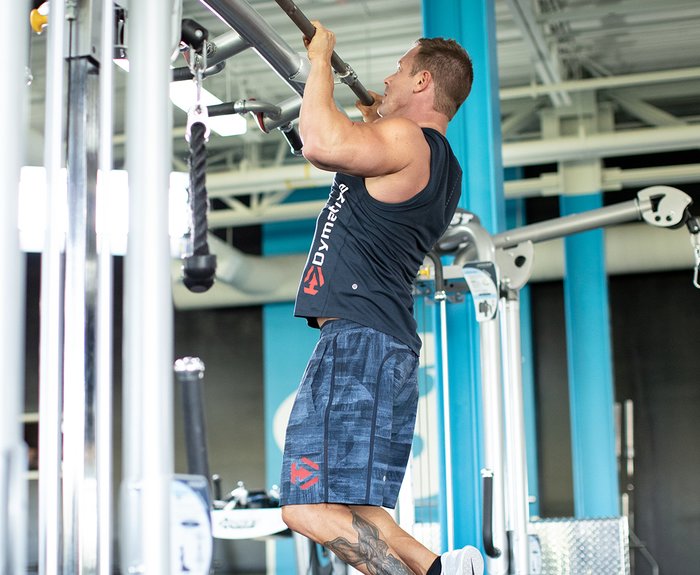
Just because it uses only body weight doesn’t mean the pull-up is an exercise to dismiss for building width! Set up with a wide grip and your arms extended, lats fully stretched. Engage your outer back and squeeze your shoulder blades together as you pull yourself up, elbows pointing in toward your lats. Your body should travel up in a straight line. No swinging! Use the assisted machine or bands if you can’t perform 6-10 reps with body weight.
Machine Crunch
Abs need varying stimuli just like any other muscle. Break the cycle of your regular crunches and give this machine a try. Actively contract your abs as you pull your elbows toward your knees. Pick a challenging enough weight for 10 reps.
Squat to Arnold Press
Hold the dumbbells at your shoulders with your palms facing you, as if you just did a dumbbell curl. Perform a squat, making sure to stay upright. Your knees should track with your toes as you reach parallel. As soon as you hit the bottom of the squat, explode up and go right into an Arnold press, rotating the dumbbells out and up.
from Weight Loss Insider https://ift.tt/2SmV3kj
via Best Weight Loss Supplement
You Should Only Weigh Yourself At This Time In The Day
Inspiration of the article:
“Our goals can only be reached through a vehicle of a plan, in which we must fervently believe, and upon which we must vigorously act. There is no other route to success.” —Pablo Picasso
Not All Weight is Considered Equal in the Day and Night
When it comes to weighing yourself, your weight differs when it comes to the timing of the day. To lose weight fast is going to take a lot more than running on the treadmill or reducing your calories (although they are crucial strategies when done strategically).
But when it comes to the terrifying weight scale, there’s nothing to fear! According to the National Weight Control Registry, 75% of people who have successfully lost weight and kept it off weigh themselves on a consistent basis. In addition, a 2012 study in the Journal of Nutrition and Dietetics found that people who regularly weigh themselves are the ones who lose weight and are less likely to gain it back!

Apparently it’s a good habit to get yourself accustomed to.
So, get your scale game on! But keep this in mind: science recommends to do so mindfully. Apparently there is a “right” way to weigh yourself. And as long as you follow this simple rule, you may get results that you can be proud of (and that are a little more accurate!)
Interesting read: This Study Reveals A Dogs Behavior Can Reveal A Lot About Weight Loss
First off, doctors recommend scheduling just one time per day to weigh yourself and stay consistent with only that time. Since your weight oscillates throughout the day, it’s hard to get an accurate read on the scale when you’re constantly on it.
“You need to know that number on a consistent basis to help you manage your weight to make better decisions about your health,” Holly Wyatt, M.D., medical director of the Wellness Clinic at the University of Colorado Anschutz Health and Wellness Center, told Consumer Reports.
However, now you’ve stumbled upon a question to ask yourself: When is the best time to weight myself, then?

Experts say you should use the scale in the morning, just after you empty out your bladder and before you eat your breakfast (or before you even make the trip to the gym). Not only will your weight be lower, but you’ll also benefit from seeing an accurate result of what you actually weigh.
It’s also important to place your scale on a flat surface and not on any carpets or a rocky surface. The incline level does matter when it comes to accuracy so make sure you’re standing still with your weight distributed evenly on both sides, across both feet. Getting a more exact result of how much you really weight is guaranteed to put your mind at rest and keep you motivated for fast weight loss (remember, only you can help yourself lose weight fast!)
from Weight Loss Insider https://ift.tt/2zxmP6D
via Best Weight Loss Supplement
High LDL cholesterol may protect against dementia – don’t tell the statin pushers!
Don’t tell the statin brigade, but elevated LDL cholesterol may actually help us as we age!
A new study from China suggests that those with higher levels of LDL-C have a lower incidence of dementia. They evaluated 3,800 subjects with a mean age of 69 years, performing extensive neuropsychological and cognitive ability testing. They found that the diagnosis of dementia and cognitive impairment correlated with increasing age, decreasing education level, diagnosis of type 2 diabetes, and being an ApoE4 carrier. After controlling for all these factors, they also found that those in the highest tertile of LDL-C (>142 mg/dL or 3.7 mmol/L) had a 50% lower incidence of dementia than those in the lowest tertile (<110 mg/dL or 2.9 mmol/L).
These findings are consistent with a prior study (also observational) examining the Framingham Heart Study data that found lower risk of dementia in those over 85 years old with higher cholesterol levels.
In fairness, these studies were observational studies, so they do not prove higher LDL-C directly protected against dementia. We can hypothesize why higher levels of LDL-C are associated with lower incidence of dementia. It could be a marker of overall health or nutritional status, it could be that LDL-C directly improves the health of neurons and prevents brain atrophy, or it could be more related to lack of diabetes or ApoE4 status for which a study may not always completely control.
Even without proving causation, these studies are wonderful reminders that we can easily get caught up in one specific disease processes (i.e. cardiovascular disease) and forget about the rest of the patient. The old joke is that when the surgeon talks to the family after a complicated and risky coronary bypass surgery, he says, “The surgery was a great success. The grafts were perfect, and the anastomosis were flawless, some of the best I have ever done. I’m sorry the patient died, but the surgery was wonderful.”
This is a fictional over-exaggeration, but it makes my point.
Cholesterol’s effects on our health are far too intricate to simply label LDL-C as “bad” and leave it at that. Such oversimplifications harm our overall understanding and eventually harms our health.
Instead, we need to focus on the whole patient, not one specific outcome. Trials should focus on all-cause mortality and overall morbidity rather than one or two specific outcomes. It doesn’t do us much good to lower heart attack risk by 0.5% over five years if we are also increasing the risk of dementia, cancer or other complications.
Thanks for reading,
Bret Scher MD FACC
Originally Posted on the Diet Doctor Blog

from Weight Loss Insider https://ift.tt/2zzKG5U
via Best Weight Loss Supplement